
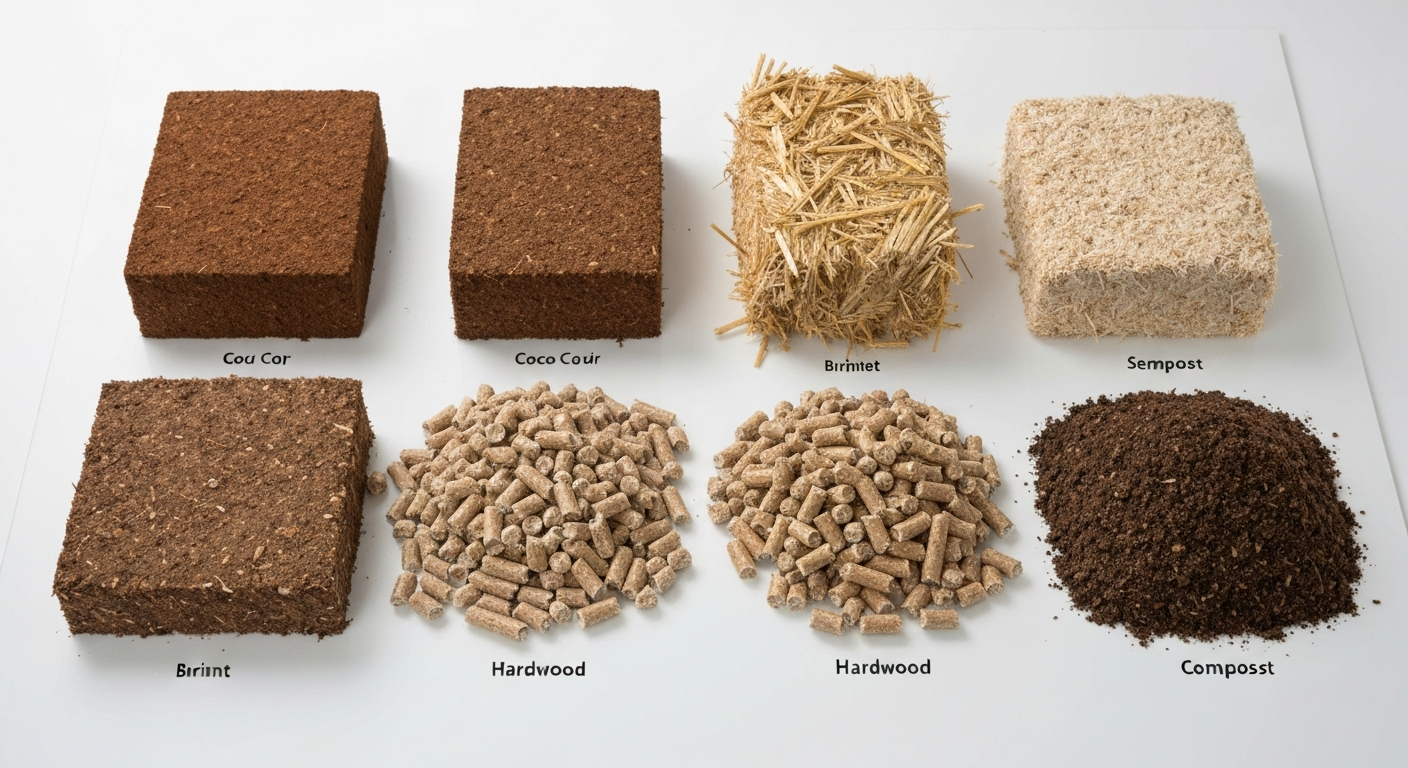
Right, look. Bulk substrates are the actual engine room. Grain spawn? That’s just the inoculation vehicle, basically a taxi service. The bulk stuff has to do the heavy lifting for primordia and fruiting. If you mess this up, yield tanks. Contam wins. Efficiency goes out the window.
We’re covering coco coir, cereal straw, hardwood sawdust, composted manure, and supplemented formulations. Sorted.
Field Capacity: The Fundamental Measurement
Single most important physical parameter. Maximum water a substrate can retain against gravity after free drainage. You gotta know this. Otherwise you’re just guessing.
The Squeeze Test
- Take a generous handful of hydrated substrate
- Squeeze firmly
- At field capacity, 2-3 drops of water should emerge
- Water streaming = over-hydrated
- No water = too dry
Target moisture: 60-65% by wet weight. Simple as that. But people mess it up all the time. Too wet and you drown the mycelium. Too dry and it stalls. Wet substrate is the number one reason for fails.
Moisture Content Targets by Substrate Type
| Substrate | Target Moisture (% wet weight) | Field Capacity Notes |
|---|---|---|
| Coco coir | 62-68% | Highly absorbent, tends toward over-hydration |
| Wheat straw | 68-74% | Hollow stems retain water internally |
| Hardwood sawdust | 60-65% | Dense, slow to hydrate uniformly |
| Composted manure | 62-68% | Variable by composition |
| CVG mix | 62-66% | Coir component dominates water retention |
Coco Coir
Coir comes from coconut mesocarp. Basically coconut husk dust. Comes in compressed bricks, consistent, low cost, nearly neutral pH. Ever dealt with pH swings ruining a batch? Coir avoids that headache. C:N ratio sits between 75:1 and 186:1. Honestly the fact it’s nutritionally poor is a proper advantage here. Supports mycelial growth from grain spawn while not feeding contaminants. Why feed the bad stuff right?
Properties are solid. pH 5.5-6.8, water holding 8-9x dry weight, bulk density 60-90 kg/m3. Holds water like a sponge but breathes.
Preparation: Bucket Tek
We use this method constantly. Dead simple.
- Break up 650g coir brick in 20L bucket
- Pour 3.5-4L boiling water
- Seal lid, wait 4-8 hours (go make a tea)
- Break apart, squeeze test, adjust moisture
- Ready for mixing with spawn
Honestly the wait is the hardest part. Just let it sit. Don’t peek. You want that heat to stay in there for pasteurisation.
Cereal Straw
Wheat/barley straw. C:N 70:1-100:1. Great for Pleurotus. Chop to 5-10cm. You gotta chop it otherwise colonisation takes forever. Hot water pasteurisation at 65-80C for 60-90 mins, or cold water lime bath (1g Ca(OH)2 per litre, pH 11-12, soak 16-24 hours).
Performance? Mental. Oyster hits 80-120% biological efficiency, 3-4 flushes. Pink oyster 70-100%. Wine cap 60-90%. Not bad for straw eh.
Straw Performance Data
| Species | Biological Efficiency on Straw | Flushes | Notes |
|---|---|---|---|
| Oyster (Pleurotus ostreatus) | 80-120% | 3-4 | Optimal substrate for this species |
| Pink oyster (Pleurotus djamor) | 70-100% | 2-3 | Performs well in warm conditions |
| Wine cap (Stropharia rugosoannulata) | 60-90% | 2-3 | Excellent outdoor substrate |
| Paddy straw (Volvariella volvacea) | 40-60% | 1-2 | Requires high temperatures (30-35C) |
Biological efficiency = (fresh weight of mushrooms / dry weight of substrate) x 100%.
Hardwood Sawdust
Oak, beech, maple, birch. C:N 300:1-500:1 so MUST supplement. It’s too carbon heavy otherwise. Mycelium starves.
Formula: 80% sawdust, 18% wheat bran, 2% gypsum, water to 60-65%.
Supplementation Options
| Supplement | Addition Rate | Resulting C:N Ratio | Notes |
|---|---|---|---|
| Wheat bran | 10-20% by dry weight | 60:1-120:1 | Standard supplement, readily available |
| Rice bran | 10-15% by dry weight | 50:1-100:1 | Higher fat content, risk of overheating |
| Soybean hull pellets | 10-20% by dry weight | 70:1-130:1 | Excellent structure, slow-release nitrogen |
| Oat bran | 10-15% by dry weight | 55:1-110:1 | Good balance of fat and protein |
MUST sterilise (121C, 15 PSI, 2.5-3 hours). Trichoderma will demolish it otherwise. Seriously don’t risk pasteurisation here. Why? Because supplements invite contaminants. One slip and you lose the whole block.
Composted Manure
Horse manure + straw for Agaricus only. Don’t use this for oysters. Waste of time. Phase I composting outdoors for 7-14 days at 70-80C, turning every 2-3 days. Phase II at 57-60C for 6-8 hours then 45-50C conditioning for 5-7 days.
Ready when ammonia below 10ppm, moisture 62-68%, pH 7.0-7.5. Should smell earthy, not sharp.
Bit of a faff but buttons need it. You can’t rush the chemistry.
The CVG Formula (Coir, Vermiculite, Gypsum)
The go-to for beginners. Reliable.
Standard CVG Recipe
| Component | Amount | Function |
|---|---|---|
| Coco coir (compressed brick) | 650g | Primary substrate, moisture retention |
| Vermiculite (coarse grade) | 2 litres (~200g) | Air space, moisture reservoir |
| Gypsum (calcium sulphate) | 40g (~2 tablespoons) | pH buffer, calcium and sulphur |
| Boiling water | 3.5-4 litres | Hydration and pasteurisation |
Preparation
- Place vermiculite and gypsum in a clean 20L bucket
- Break the coir brick into chunks and add to the bucket
- Pour boiling water over the mixture. Start with 3.5L
- Close lid, rest 4-8 hours
- Break apart thoroughly, mix to uniform consistency
- Squeeze test. Adjust with more boiling water or dry vermiculite
Works because C:N over 100:1. Contaminants can’t establish. Can be pasteurised not sterilised, which makes life much easier. The vermiculite creates tiny air pockets for gas exchange. Mycelium needs oxygen and produces CO2, so without those air spaces you get stalling and overlay.
Spawn-to-Substrate Ratios
More spawn means faster colonisation. Simple as. But it costs more. Pay to play basically.
| Spawn Rate | Colonisation Time | Contamination Risk | Cost Efficiency |
|---|---|---|---|
| 5% (by weight) | 14-21 days | Higher | Most economical |
| 10% (standard) | 10-14 days | Moderate | Balanced |
| 20% | 7-10 days | Lower | Least economical |
| 30%+ | 5-7 days | Lowest | For dodgy environments |
10% is the standard recommendation. If your cleanliness isn’t perfect, bump that ratio up. Rates below 5% are asking for trouble.
Pasteurisation vs Sterilisation
Low-nutrient (coir, CVG, straw): pasteurise 60-82C, 1-2 hours. Reduces contam load while preserving beneficial organisms that help fight off competitors.
Supplemented (sawdust+bran): sterilise 121C, 15 PSI, 2+ hours. Eliminates everything, including the good stuff, but necessary when the nutrient content would otherwise feed aggressive contaminants.
More nutritious = more thorough treatment. Sterilised nutrient-rich substrate is a blank slate. First organism to colonise wins. Basically a race. You want your mycelium to win. Don’t let the trich beat you to it.
Related Reading
- Grain Substrates: A Comprehensive Guide. Understanding grain spawn, the inoculation vehicle for all bulk substrates
- Pasteurization Techniques for Bulk Substrates. Detailed protocols for the thermal treatment methods referenced in this guide
- The Science of Contamination in Mushroom Cultivation. Understanding the organisms that bulk substrate preparation aims to control