
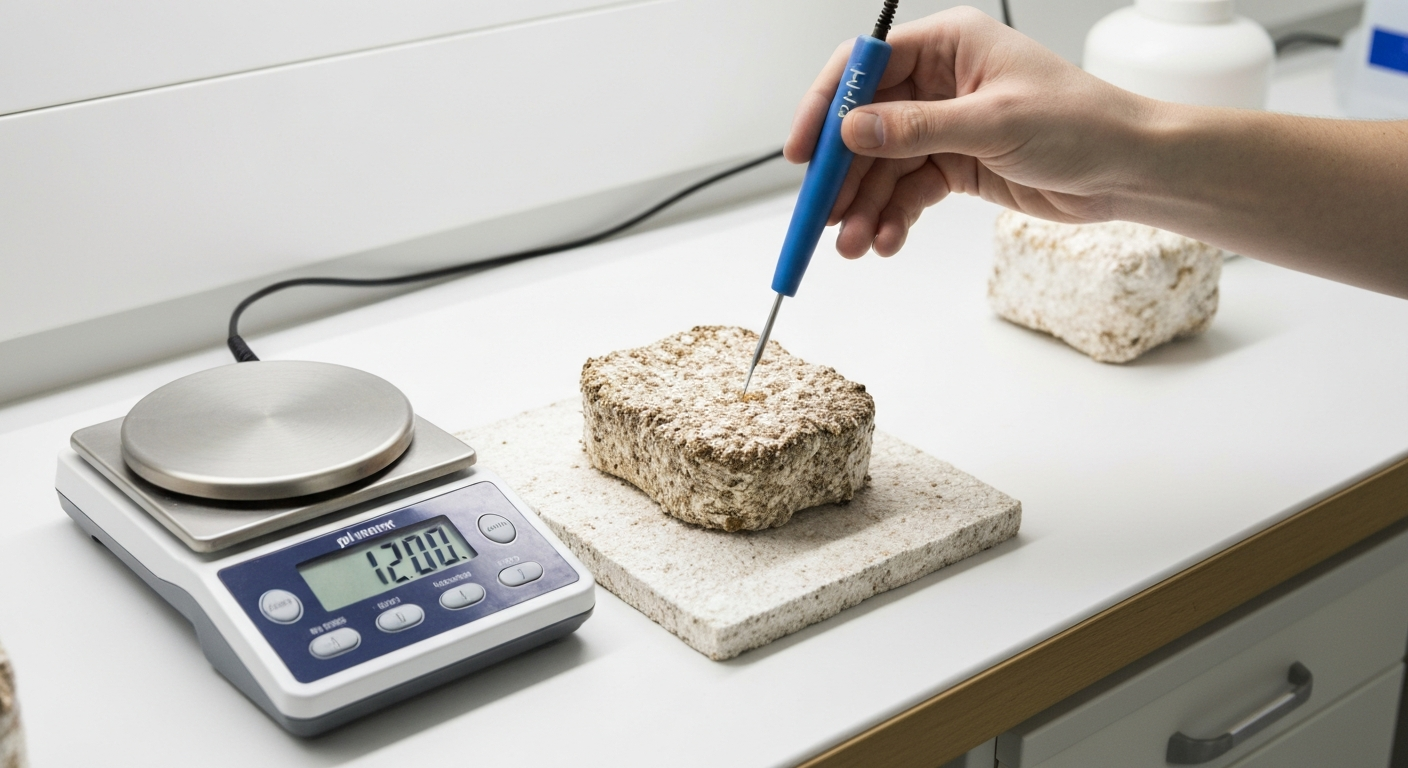
Look, growing mushrooms isn’t magic. It’s chemistry. Plain and simple.
Ever wondered why your spawn runs slow or why you get that green mould halfway through? Usually comes down to three parameters. Get these right and you replace guesswork with data. C:N ratio, pH, and moisture content. That’s it.
C:N Ratio: The Fundamental Balance
Carbon provides energy plus cell walls. Nitrogen handles proteins and enzymes. Simple biology.
- High C:N (above 60:1). Nitrogen-limited. Colonisation is slower but contamination risk drops. Bacteria have higher nitrogen requirements than fungi, so they starve too.
- Low C:N (below 20:1). Bacteria love it. HIGH contam risk unless sterilised and handled with strict aseptic technique.
- Optimal (20:1 to 40:1). Balanced nutrition. Vigorous mycelial growth, efficient enzyme production. The sweet spot.
C:N Ratios of Common Substrates
Here’s the breakdown. Keep this handy.
| Substrate | C:N Ratio | Carbon (% DW) | Nitrogen (% DW) | Primary Use |
|---|---|---|---|---|
| Wheat straw | 80:1–100:1 | 42–46 | 0.4–0.6 | Bulk substrate (pasteurised) |
| Barley straw | 70:1–90:1 | 42–45 | 0.5–0.7 | Bulk substrate (pasteurised) |
| Hardwood sawdust | 350:1–500:1 | 48–52 | 0.1–0.15 | Supplemented fruiting blocks |
| Softwood sawdust | 400:1–700:1 | 50–54 | 0.08–0.12 | Generally unsuitable (resinous) |
| Coco coir | 75:1–110:1 | 42–48 | 0.4–0.6 | Bulk substrate, casing |
| Rye grain | 25:1–30:1 | 42–44 | 1.5–1.8 | Grain spawn |
| Wheat grain | 22:1–28:1 | 42–44 | 1.6–2.0 | Grain spawn |
| Soya bean hulls | 30:1–40:1 | 43–47 | 1.2–1.5 | Supplementation |
| Wheat bran | 15:1–20:1 | 43–46 | 2.3–3.0 | Supplementation |
| Cottonseed meal | 7:1–10:1 | 42–45 | 5.0–7.0 | Supplementation (use sparingly) |
| Corn cobs | 55:1–65:1 | 44–48 | 0.7–0.9 | Bulk substrate |
| Coffee grounds (spent) | 20:1–25:1 | 40–45 | 1.8–2.3 | Supplementation or sole substrate |
| Composted horse manure | 15:1–25:1 | 30–38 | 1.5–2.5 | Agaricus substrate |
| Vermiculite | N/A (inert) | 0 | 0 | Structural amendment, casing |
See that sawdust? 350-500:1 is mental. You gotta supplement that or the mycelium starves. Target for supplemented hardwood blocks (masters mix) is typically 40:1-60:1.
Optimal C:N Ratios by Species
Different mushrooms want different things. Ever tried fruiting shiitake on straw? Yeah, doesn’t go well. They need specific lignin.
| Species | Ecological Role | Optimal C:N Range | Notes |
|---|---|---|---|
| Pleurotus ostreatus (oyster) | Primary decomposer | 30:1–80:1 | Extremely versatile; tolerates wide range |
| Pleurotus djamor (pink oyster) | Primary decomposer | 40:1–80:1 | Slightly less nitrogen-demanding |
| Hericium erinaceus (lion’s mane) | Primary/wound parasite | 30:1–50:1 | Prefers supplemented hardwood |
| Lentinula edodes (shiitake) | Primary decomposer | 35:1–55:1 | Requires specific lignin content |
| Ganoderma lucidum (reishi) | Primary decomposer | 40:1–70:1 | Tolerant; long colonisation period |
| Agaricus bisporus (button) | Secondary decomposer | 15:1–20:1 | Requires composted substrate |
| Pholiota nameko | Primary decomposer | 30:1–50:1 | Similar requirements to shiitake |
| Stropharia rugosoannulata (wine cap) | Primary decomposer | 50:1–100:1 | Thrives on raw straw |
| Flammulina velutipes (enoki) | Primary decomposer | 30:1–50:1 | Performs well on supplemented sawdust |
| Auricularia auricula-judae (wood ear) | Primary decomposer | 40:1–60:1 | Prefers hardwood substrates |
These are guidelines, not absolute rules. Most species produce some yield outside their optimal range, but maximum biological efficiency is achieved within these windows.
Calculating C:N Ratios
Need to calculate it yourself? Here’s the formula.
C:N ratio = (Σ mass_i × C%_i) / (Σ mass_i × N%_i)
Basically, you weigh the carbon content against the nitrogen. Dead simple.
Worked Example: Masters Mix
Masters mix is a 50:50 blend (by dry weight) of hardwood sawdust and soya bean hulls. Here’s how it works out.
| Component | Dry Weight (g) | Carbon (%) | Nitrogen (%) | C Contribution (g) | N Contribution (g) |
|---|---|---|---|---|---|
| Hardwood sawdust | 500 | 50 | 0.12 | 250 | 0.60 |
| Soya bean hulls | 500 | 45 | 1.35 | 225 | 6.75 |
| Total | 1000 | . | . | 475 | 7.35 |
C:N ratio = 475 / 7.35 = 64.6:1
Falls within the acceptable range for most wood decomposers. Some cultivators add 5-10% wheat bran to bring it closer to 40:1-50:1 for nitrogen-hungry species like Hericium erinaceus.
pH
Most species prefer pH 5.0-7.0. Why does this matter? Contamination.
pH Optima for Cultivated Species
| Species | Optimal pH Range | Tolerated pH Range | Notes |
|---|---|---|---|
| Pleurotus ostreatus | 5.5–6.5 | 4.0–9.0 | Exceptionally tolerant of alkaline conditions |
| Pleurotus djamor | 5.5–6.5 | 4.5–8.5 | Similar to P. ostreatus |
| Hericium erinaceus | 5.0–6.0 | 4.5–7.0 | More sensitive to alkaline conditions |
| Lentinula edodes | 4.5–5.5 | 3.5–6.5 | Prefers distinctly acidic substrates |
| Ganoderma lucidum | 5.0–6.5 | 4.0–7.5 | Moderate tolerance |
| Agaricus bisporus | 6.8–7.2 | 6.0–8.0 | Near-neutral; sensitive to extremes |
| Stropharia rugosoannulata | 5.5–7.0 | 4.5–8.0 | Broad tolerance |
| Flammulina velutipes | 5.0–6.0 | 4.0–7.0 | Prefers mildly acidic |
pH Shifts During Processing
pH changes during processing and colonisation. Thermal processing causes slight acidification (Maillard reaction). Colonisation acidifies further as mycelium produces oxalic and citric acids.
| Substrate | Native pH | After Pasteurisation | After Sterilisation | After Full Colonisation |
|---|---|---|---|---|
| Wheat straw | 6.5–7.5 | 6.0–7.0 | 5.5–6.5 | 4.5–5.5 |
| Hardwood sawdust | 5.0–6.5 | 4.5–6.0 | 4.5–5.5 | 4.0–5.0 |
| Coco coir | 5.5–6.8 | 5.5–6.5 | 5.0–6.0 | 4.5–5.5 |
| Rye grain | 5.5–6.5 | . | 5.0–5.5 | 4.5–5.0 |
| Composted manure | 7.0–8.5 | 7.0–7.5 | . | 6.0–7.0 |
Adjusting pH
Increasing (more alkaline):
- Hydrated lime (1-5g/kg dry substrate). Used in lime pasteurisation. Raises pH fast, provides calcium.
- Gypsum (10-30g/kg). pH buffer, not a strong alkaliser. Prevents excessive pH drops.
Decreasing (more acidic):
- Citric acid (1-3g/kg). Mild, controlled. For species wanting acid conditions like shiitake.
- Natural acidification. Most substrates acidify on their own during colonisation. If starting pH is in range, don’t bother adjusting.
pH and Contamination
Bacteria prefer neutral-alkaline (6.5-8.0). Fungi tolerate acid. This is EXACTLY why lime pasteurisation works for Pleurotus. You push the pH where bacteria hate it but mushrooms don’t care.
One thing though. Grain spawn at pH 5.5-6.5 with C:N 22-30:1 MUST be sterilised. No way around it. Too much food at the wrong pH and you’re asking for trouble.
Moisture
Field capacity = max water substrate holds against gravity. You know the squeeze test. Few drops = perfect. Too wet = anaerobic = bacterial contamination. Too dry = mycelium stalls. It’s a balancing act.
Targets by Substrate Type
| Substrate | Optimal Moisture (% wet weight) | Field Capacity Behaviour | Notes |
|---|---|---|---|
| Grain spawn | 45–55% | No visible water when squeezed; grain dents but doesn’t burst | Lower than bulk substrates to inhibit bacteria |
| Wheat straw | 68–75% | 2–4 drops when squeezed firmly | Standard for oyster mushroom cultivation |
| Coco coir | 65–72% | Similar to straw; coir has excellent water retention | Rehydrate compressed bricks carefully |
| Hardwood sawdust (supplemented) | 60–65% | Compacts when squeezed; springs back slowly | Too wet = bacterial contamination; too dry = slow colonisation |
| Composted manure | 62–68% | Holds shape when compressed; glistens but does not drip | Critical for Phase II composting success |
| Vermiculite (casing) | 60–70% | Absorbs and releases water readily | Used as moisture reservoir in casing layers |
Measuring Moisture Content
Gravimetric analysis (weigh wet, dry at 105C for 24h, weigh dry, calculate) is the accurate method. For routine work, the hand-squeeze test is fine. Use gravimetric when developing new formulations or troubleshooting.
MC (%) = ((wet weight - dry weight) / wet weight) x 100
Moisture and Gas Exchange
Too much water fills the spaces between particles, blocking gas diffusion. CO2 accumulates, O2 depletes, and you get anaerobic conditions that promote bacterial growth and fermentative odours. Too dry and the mycelium stalls, forming survival structures instead of growing.
Moisture Management Through Cultivation
| Phase | Moisture Gain | Moisture Loss | Management |
|---|---|---|---|
| Incubation | Metabolic water (minor) | Evaporation through filter patches | Seal containers, maintain 60-70% ambient RH |
| Fruiting initiation | Misting, humidity control | Surface evaporation | Increase to 85-95% RH |
| Fruiting | Misting | Transpiration from fruiting bodies | 85-95% RH, balance FAE against moisture loss |
| Between flushes | Soaking (dunking) | Post-soak draining | Immerse in clean water 2-12 hours |
Rehydration between flushes is essential. Mushrooms are roughly 90% water. Without rehydration, subsequent flushes tank in yield.
Supplementation
This is where people mess up. They want bigger yields so they chuck in too much bran.
Common Supplements
| Supplement | C:N Ratio | Protein (% DW) | Application Rate (% DW) | Notes |
|---|---|---|---|---|
| Wheat bran | 15:1–20:1 | 15–17 | 5–15 | Most widely used; effective and predictable |
| Rice bran | 18:1–22:1 | 12–15 | 5–15 | Similar to wheat bran; more common in Asia |
| Soya bean hulls | 30:1–40:1 | 9–12 | 20–50 | Primary component of masters mix |
| Cottonseed meal | 7:1–10:1 | 40–45 | 2–5 | Very high nitrogen; use sparingly |
| Gypsum (CaSO₄·2H₂O) | N/A (mineral) | 0 | 1–3 | pH buffer; calcium and sulphur source |
| Spent coffee grounds | 20:1–25:1 | 10–12 | 5–20 | Readily available; variable quality |
| Alfalfa meal | 12:1–15:1 | 15–18 | 3–8 | High nitrogen; increases contamination risk |
The Supplementation Threshold
Pasteurised substrates max out at 5-10% bran before Trich risk spikes. The extra nitrogen drops the C:N ratio below the safety threshold for non-sterile handling.
Sterilised substrates can go higher (up to 25-30% bran) since sterilisation kills everything. But diminishing returns kick in. Above a certain level, excess nitrogen just feeds any contaminant that gets in.
| Supplementation Rate | Effect on C:N Ratio | Contamination Risk | Expected Yield Increase | Recommended Processing |
|---|---|---|---|---|
| 0% (unsupplemented) | Base substrate ratio | Low | Baseline | Pasteurisation adequate |
| 5% wheat bran | Moderate reduction | Low–Moderate | +10–20% | Pasteurisation or sterilisation |
| 10% wheat bran | Significant reduction | Moderate | +20–35% | Sterilisation recommended |
| 15% wheat bran | Large reduction | Moderate–High | +25–40% | Sterilisation required |
| 20%+ wheat bran | Very low C:N ratio | High | Variable (diminishing returns) | Sterilisation required; marginal benefit |
See that 20%+ line? High contam. Diminishing returns. Not worth it unless you’ve got a flow hood dialled in perfectly.
Delayed-Release Supplementation
Clever alternative: add supplements after the substrate is partially or fully colonised. By the time the extra nutrients become available, your mycelium is already dominant. Commercial delayed-release supplements are pelletised with wax coatings that dissolve slowly over weeks. Can increase biological efficiency 15-30% for Pleurotus and Lentinula without the corresponding contamination spike.
How These Interact
These three parameters don’t operate independently. They form a system.
- C:N and contamination. Low C:N demands sterilisation. High C:N permits pasteurisation. This determines your entire workflow.
- Moisture and bacteria. Excess moisture creates anaerobic microsites. A substrate at C:N 25:1 and 55% moisture might be fine. Same ratio at 75% moisture is virtually guaranteed to go bacterial.
- pH and competition. Alkaline (above 8.0) inhibits Trich more than Pleurotus. This is why lime pasteurisation works.
- Supplementation and moisture. Adding dry supplements reduces moisture content. Account for this by pre-hydrating or adding more water.
- Sterilisation and pH. Thermal processing drops pH by 0.5-1.0 units. Substrates at the low end of optimal range may become too acidic after sterilisation.
Systematic Formulation
- Pick your species. Look up optimal C:N, pH, and moisture from the tables above.
- Choose a base substrate. Availability, cost, compatibility.
- Calculate the C:N ratio. Use the formula.
- Supplement if needed. Recalculate after each addition.
- Choose processing method. C:N above 60:1 and no supplements = pasteurise. Below 40:1 or supplemented = sterilise.
- Hydrate to target moisture.
- Check pH. Adjust if needed, remembering the shift from processing.
- Test batch first. Small batch, monitor colonisation and contamination, then scale.
Right. So you’ve got the numbers. Be honest with yourself about your sterile technique.
Related Reading
- Grain Substrates. Nutritional profiles and C:N ratios of the five principal grain types
- Sterilization Methods. Thermal processing for high-nutrient substrates
- Pasteurisation Techniques. When the C:N ratio permits non-sterile processing
- The Science of Contamination. How substrate chemistry influences contaminant susceptibility