
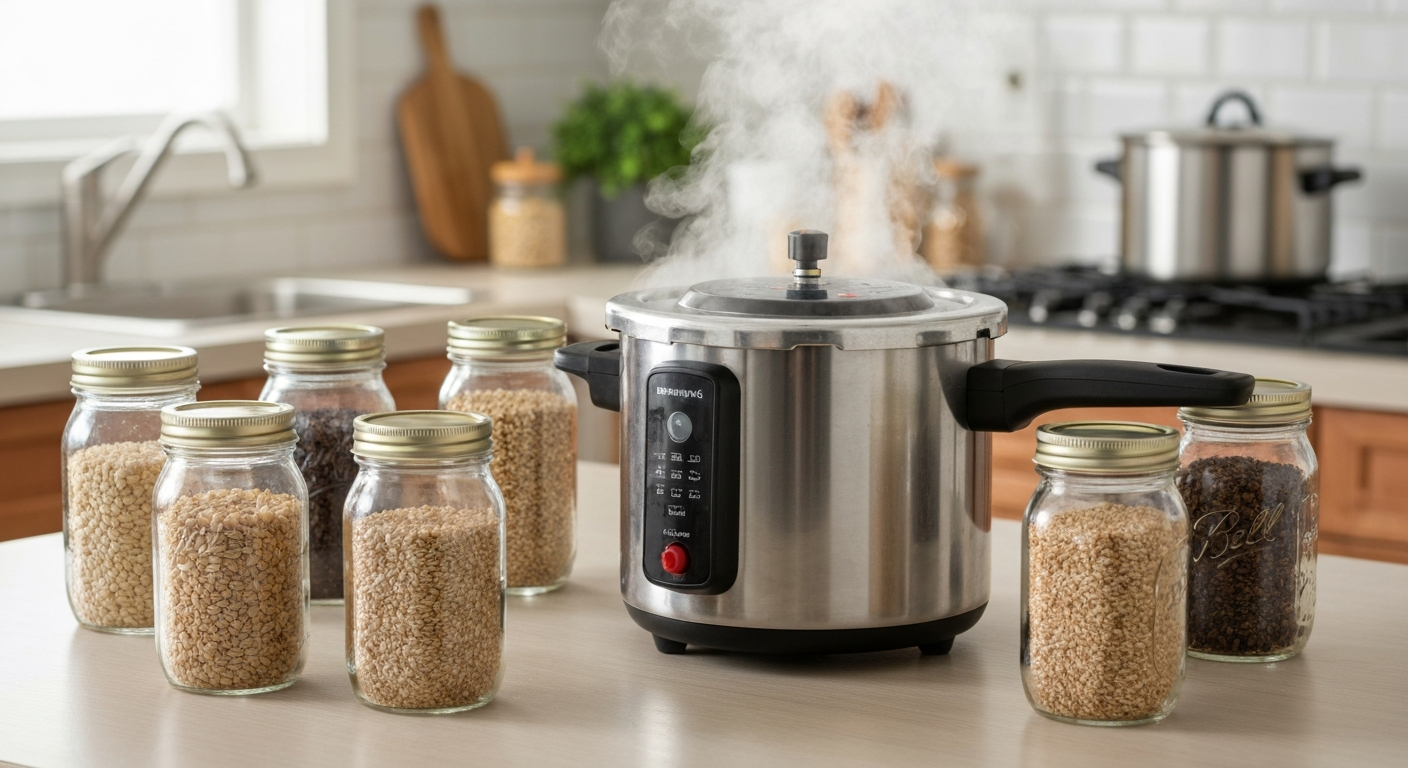
Look, sterilisation isn’t optional. It eliminates ALL viable organisms from a substrate. Unlike pasteurisation which just reduces them (big difference). Critical for grain spawn, agar, and supplemented substrates.
Ever tried running a grow room without proper sterilisation? Yeah, doesn’t go well. You’ll spend weeks waiting for mycelium only to watch green mould take over. Honestly, it’s gutting.
Principles of Thermal Sterilisation
Moist heat at 121C (15 PSI) denatures proteins and nucleic acids including Bacillus and Clostridium endospores. Boiling (100C) isn’t enough. Endospores survive hours of boiling. D-value for B. stearothermophilus at 121C is 1.5-2.0 minutes. 15 min at 121C achieves 10^-6 sterility assurance. But the entire substrate must reach 121C.
Basically, you’re trying to kill things that laugh at boiling water. Those endospores are tough little bastards. You need the temp to hit 121C throughout the whole load, not just at the surface. If the centre of your grain bag is still cold, you’re done for.
Pressure Cooking
Steam is the sterilising agent, not pressure. Pressure just raises the boiling point. Must vent for 10-15 mins first to purge air. If you skip venting, the trapped air dilutes the steam atmosphere and you might hit 15 PSI without actually reaching 121C. Bad news.
Equipment
Don’t cheap out on this. A wobbly lid means contaminated spawn.
| Equipment Type | Capacity | Max Pressure | Suitability | Approximate Cost |
|---|---|---|---|---|
| Presto 23-quart | 21.8L | 15 PSI | Hobby | £60-90 |
| All American 921 | 20.3L | 15 PSI | Hobby | £250-350 |
| All American 941 | 39.3L | 15 PSI | Small-medium | £350-500 |
| Lab autoclave (benchtop) | 20-50L | 15-30 PSI | Medium, precise | £1,500-5,000 |
See the price jump on the All Americans? You’re paying for durability. Metal-to-metal seal instead of a rubber gasket, so no gasket replacement. The Presto is fine to start (we all started there) but the gaskets wear out.
Sterilisation Times at 15 PSI (121C)
| Substrate | Container | Sterilisation Time | Notes |
|---|---|---|---|
| Grain spawn | Quart jar (950ml) | 90 minutes | Standard protocol for all grain types |
| Grain spawn | Spawn bag (2.5kg) | 120 minutes | Greater thermal mass |
| Grain spawn | Spawn bag (5kg) | 150 minutes | Centre needs extended time |
| Agar media | Petri dish stack / 500ml flask | 30-45 minutes | Liquid heats rapidly |
| Supplemented sawdust | Spawn bag (2.5kg) | 150 minutes | Higher contam risk |
| Supplemented sawdust | Spawn bag (5kg) | 180 minutes | Conservative time recommended |
| Liquid culture | Quart jar (600ml) | 30 minutes | Over-sterilisation causes caramelisation |
| Bulk grain | 5-gallon bucket bag (10L+) | 180-240 minutes | Consider splitting into smaller units |
Why the variation? Density. A quart jar heats faster than a 5kg bag. Simple physics. Don’t guess on this or you’ll waste weeks. When in doubt, add 15-30 minutes rather than risk a failed batch.
The Protocol
- Load with trivet + 50-75mm water. Jars off the bottom or they’ll scorch.
- Seal the cooker.
- Vent 10-15 minutes with weight off. Purges trapped air.
- Build to 15 PSI, start timing only when gauge is steady.
- Maintain steady 15 PSI. Fluctuations cause suck-back where unsterile air gets drawn into containers.
- Natural depressurisation. NEVER manual release. You’ll boil your jars dry and crack the glass. Let it sit. Go have a beer. Come back when it’s cool.
- Cool to room temp, ideally overnight. Opening a hot PC in a non-sterile environment exposes warm, moist substrates to airborne contaminants at the worst possible moment.
Autoclaving
Same principles but better control: ±0.5-1C vs ±3-5C, automated, vacuum-assisted air removal, electronic logs. Pre-vacuum cycles are best for dense substrates like supplemented sawdust blocks where trapped air pockets insulate the interior.
Unless you’re scaling hard (100+ units/week), you probably don’t need one. They’re brilliant but the cost is hard to justify for hobbyists.
Tyndallisation (Fractional Sterilisation)
No pressure needed. Three cycles: heat to 100C for 45-60 min, incubate at 25-35C for 24h. Repeat 3 times. Endospores germinate between cycles then get killed.
| Cycle | Heating | Temperature | Duration | Incubation | Duration |
|---|---|---|---|---|---|
| 1 | Steam or boil | 100C | 45-60 min | Room temp (25-30C) | 24 hours |
| 2 | Steam or boil | 100C | 45-60 min | Room temp (25-30C) | 24 hours |
| 3 | Steam or boil | 100C | 45-60 min | - | Inoculate upon cooling |
Honestly, only use this if your pressure cooker blows up. It’s three days of waiting. You heat it, let spores wake up, then kill them. Clever, but slow. Not reliable for high-nutrient substrates. And if it’s too cool between cycles (below 20C), the endospores won’t germinate and you’ve wasted three days.
Sterile Technique
Even perfect sterilisation is meaningless if you introduce contaminants during inoculation.
Laminar flow hood: HEPA filtered air, 99.97% efficient at 0.3um. The single most impactful piece of equipment after a pressure cooker.
Still air box: Large plastic tub with arm holes. Cheap alternative that works. We used SABs for years before upgrading. In still air, particles settle downward instead of blowing around laterally.
Essential practices:
- Flame sterilise all tools. Scalpels and needles to glowing red, let cool momentarily before use.
- 70% isopropyl alcohol on surfaces, gloved hands, jar lids. Wait, why 70% and not 99%? Higher % evaporates too fast. 70% stays wet long enough to actually kill stuff. Counter-intuitive, right?
- Minimise exposure time. Lids off for the shortest possible duration.
- Wear gloves and mask. Oral bacteria are a real contamination source.
- Clean environment. No drafts, no open windows. Some cultivators mist the room 30 minutes before to settle airborne particles.
- Seal immediately after inoculation. Micropore tape, injection ports, or impulse sealer.
Failure Diagnosis
Something went wrong? Don’t just bin it. Look at what happened.
| Contaminant | Appearance | Likely Cause | Prevention |
|---|---|---|---|
| Bacillus spp. (wet spot) | Slimy, sour-smelling grain | Under-sterilisation or excess moisture | Extend time, dry grain better |
| Trichoderma spp. | Green mould, 5-14 days post-inoc | Poor sterile technique | Improve flow hood/SAB practices |
| Aspergillus spp. | Yellow/green/black powder | Airborne during cooling or inoculation | Seal before cooling, better air filtration |
| Penicillium spp. | Blue-green patches | Contaminated inoculum | Test inocula on agar first |
| Yeast | Creamy wet colonies, fermentation smell | Under-sterilisation | Sterilise LC at 121C for 30 min minimum |
See that Bacillus line? Slimy sour grain. That’s usually moisture issues. Too wet inside the jar. And Trich? That’s on you. Poor technique. Be honest with yourself.
For more on contamination biology, see The Science of Contamination.
Sterilisation and Substrate Chemistry
Worth knowing: prolonged 121C exposure causes Maillard reactions (browning). Moderate browning is normal and harmless, but over 3 hours for small volumes can reduce amino acid bioavailability. Grain pH typically drops from 5.5-6.5 to about 5.0-5.5 after pressure cooking, which actually favours fungal growth over bacteria. Adding gypsum at 1-3% buffers this shift.
Equipment Safety
These things are pressure vessels. They can explode. Not kidding.
- Inspect gaskets before each use. Replace annually or when cracked.
- Clean vent tubes. Blocked vent = dangerous over-pressurisation.
- Calibrate gauges annually. Inaccurate gauge = under-sterilisation.
- Never overfill. Can block the vent tube or safety valve.
- NEVER open under pressure. Explosive release of superheated steam. You’ll wear your substrate across the room.
Follow the times, keep it clean, don’t rush the cool down.
Related Reading
- Pasteurisation Techniques for Bulk Substrates. When full sterilisation is unnecessary
- Grain Substrates: A Comprehensive Guide. Preparation protocols for the substrates most commonly sterilised
- The Science of Contamination. Understanding the organisms sterilisation aims to eliminate
- Substrate Chemistry. How thermal processing affects substrate chemistry