
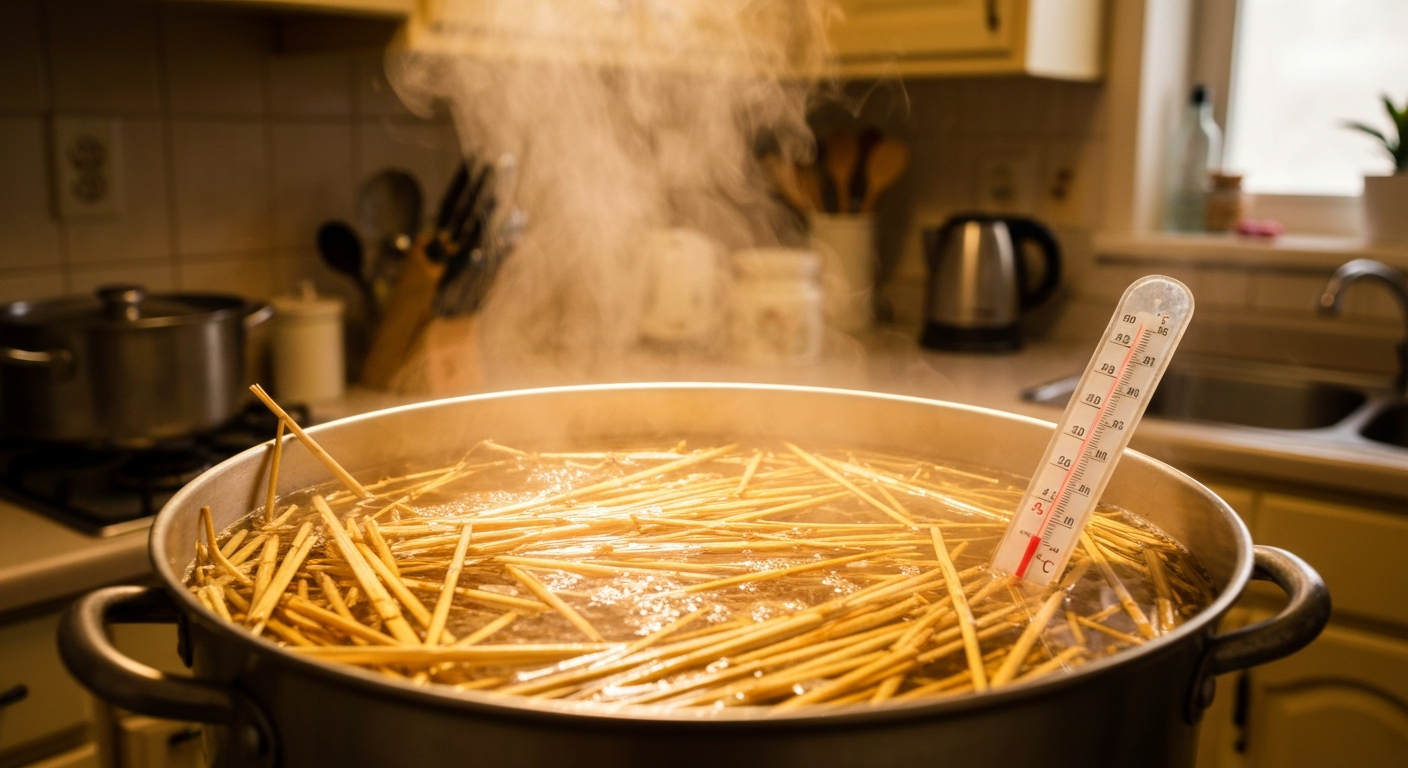
Look, everyone wants sterile substrate. But do you actually need it? Honestly, mostly no. Pasteurisation isn’t about nuking everything. It reduces microbial populations WITHOUT eliminating all organisms. Creates a selective environment where your fungus dominates. It’s the standard for bulk substrates.
Why Pasteurise Not Sterilise?
Sterilised substrate equals biological vacuum. First contaminant spore that lands colonises freely. Ever tried fighting trich in a sterile jar? Yeah, doesn’t go well. Pasteurised substrate retains heat-tolerant beneficial bacteria that compete with contaminants. Called “competitive exclusion” or “biological buffer.”
We see people sterilising straw all the time and wondering why they get contaminants. It’s because you killed the good guys too.
When to Pasteurise vs When to Sterilise
| Criterion | Pasteurisation | Sterilisation |
|---|---|---|
| Substrate nutrient density | Low to moderate (straw, coir, manure) | High (grain, supplemented sawdust) |
| Supplementation | None or light | Moderate to heavy |
| Working environment | Non-sterile (open room) | Sterile (flow hood or SAB) |
| Target species | Aggressive colonisers (Pleurotus, Stropharia) | Slower colonisers (Hericium, Ganoderma) |
| Equipment needed | Large pot, drum, or vessel | Pressure cooker or autoclave |
Rule of thumb: C:N ratio above 60:1 can pasteurise. Below 40:1 must sterilise. So if you’re working with coir, why are you buying a pressure cooker? Save the sterilisation for the high nutrient stuff where contaminants have a feast waiting.
Hot Water Immersion
Temp 65-82C (ideal 71-77C). Duration 60-120 min (best 75-90). Below 65C doesn’t kill enough. Above 82C kills beneficial bacteria too. It’s a narrow window but you’ll get it.
Temperature and Time Parameters
| Parameter | Minimum | Optimum | Maximum | Notes |
|---|---|---|---|---|
| Water temperature | 65C | 71-77C | 82C | Measured at substrate core, not surface |
| Immersion duration | 60 min | 75-90 min | 120 min | Timing begins when core temp is reached |
| Substrate : water ratio | 1:3 (v/v) | 1:4-1:5 (v/v) | 1:6 (v/v) | Enough water ensures thermal mass |
Protocol for Straw
- Chop to 50-100mm. Garden shredder or chaff cutter. Shorter lengths hydrate more uniformly.
- Load into mesh bag in vessel. Mesh bag makes drainage easier.
- Heat water to 77-82C. Slightly above target to account for heat loss when substrate goes in.
- Submerge fully. Weight down with lid, bricks, or metal plate. Air pockets create cold spots.
- Monitor core temp. Probe thermometer into the centre. Timing starts when core hits 65C+.
- Maintain 60-90 min above 65C. Wrap the drum in old sleeping bags or insulation to reduce heat loss.
- Drain. Cool to below 30C before spawning. Hot substrate kills mycelium.
- Field capacity test. Squeeze a handful firmly. Few drops of water = perfect. Dripping freely = too wet.
Common Errors
- Insufficient water volume. Not enough thermal mass, temp drops below 65C. Use at least 3:1 water to substrate.
- Cold spots. Air pockets in tightly packed straw. Agitate gently after loading.
- Over-pasteurisation. Above 82C kills the beneficial bacteria. Then it behaves like a badly sterilised medium. Vulnerable without the microbial buffer.
- Spawning too hot. Step 5 is where people mess up. You gotta monitor core temp. Surface temp means nothing if the inside is cold. And don’t spawn too hot. Ever tried spawning into hot substrate? Cooks the myc. Wait until it’s below 30C.
Cold Water Lime Bath
Hydrated lime Ca(OH)2 at 1-2g/L, pH 12-12.5 destroys cell membranes. No heat needed.
Protocol
- Prepare lime solution. Dissolve builders’ lime (NOT agricultural lime) at 1-2g per litre. For a 200L drum, that’s 200-400g of lime. Water goes milky.
- Submerge straw. Full submersion, weight down.
- Soak 16-24 hours. 12 hours minimum for finely chopped substrates.
- Drain 2-4 hours. Residual pH will be 8.5-9.5, which gradually neutralises as mycelium produces organic acids.
- Test pH (recommended). Should be 8.0-9.5. Above 10.0 means excess lime, which may inhibit growth. Rinse briefly if needed.
This is EXACTLY what you need for outdoor grows. No propane, no heating elements. Just lime and water. The pH spike kills the bad stuff while you sleep. Basically free pasteurisation. Works great for Pleurotus species which tolerate the elevated pH. Not great for Agaricus.
Steam Pasteurisation
Atmospheric steam at 60-82C for 6-12 hours. Produces substrate at the correct moisture content without needing to drain.
Drum Method (20-50kg batches)
- Hydrate substrate to field capacity (65-75% moisture) before steaming
- Load drum. Perforated false bottom 100-150mm above bottom of 200L steel drum
- Add 20-30L water below the false bottom
- Seal and heat. Tight lid with small vent (not airtight). Propane burner or electric element.
- Monitor core temp. 65-82C for 90-120 minutes.
- Cool below 30C before spawning. Sealed drum protects from airborne contam.
Thermometer Selection
| Instrument | Accuracy | Suitability |
|---|---|---|
| Dial probe | ±2C | Basic, adequate for hot water baths |
| Digital probe | ±0.5C | Recommended for all methods |
| Thermocouple with logger | ±0.3C | Ideal for process validation |
| Infrared | ±2C (surface only) | NOT suitable. Surface isn’t core temp. |
See that infrared row? Don’t bother. Surface temp isn’t core temp.
Substrate-Specific Notes
- Straw: Classic. C:N 75-100:1. Hot water 71-77C for 60-90 min. Chop to 50-100mm.
- Coco coir: Bucket tek. Boiling water in insulated container, 4-8 hours. Dead simple and remarkably effective.
- Hardwood pellets: Same bucket tek method. 1.5-2 parts boiling water to 1 part pellets. They expand into fine sawdust at field capacity.
- Manure: Phase I composting at 60-80C for 7-14 days first, then Phase II at 57-62C for 6-8 hours. Don’t try to pasteurise raw manure without composting. Smells awful and invites contaminants.
Post-Pasteurisation
Spawn within 2-4 hours of reaching 30C. Why the rush? Because once it cools, contaminants start landing again. You want your myc established before the bad stuff wakes up.
- Basic hygiene. Clean surfaces, tools, and hands. Not full sterile technique, but don’t be a slob.
- 10-20% spawn rate. Rapid colonisation outpaces recovering contaminants. Up to 25% for sketchy conditions.
- Seal and incubate at 22-27C until full colonisation.
So get your spawn ready before you start pasteurising. Right, get cracking then.
Related Reading
- Sterilization Methods. When pasteurisation isn’t enough
- Grain Substrates. Preparing the spawn used to inoculate pasteurised substrates
- Substrate Chemistry. The science behind choosing pasteurisation vs sterilisation
- The Science of Contamination. Understanding the organisms pasteurisation suppresses